


Horiba UV300
The UV300 is a cost effective water analyser for applications focused on one or two parameters.
Mainly based on UV spectroscopy, well known for its stability and low operating cost, the UV300 can measure parameters like organic matter, nitrate, colour, aromatics hydrocarbons (PAH).A complementary module allows the measurement of PO4, Cl2, NO2, Fe, Al by colorimetric method and turbidity by laser diode. External probes can be added for physicochemical parameters like pH, ORP, dissolved oxygen and conductivity. Thanks to its automatic cleaning system and its extremely long life time lamp, the maintenance is roughly limited to the periodic refill of the inexpensive cleaning solution. A new web-based interface allows the control and the troubleshooting from internet on laptop, tablet or iPhone.
Measure. Monitor. Repeat.
For better insights, better decision-making and better process performance.
Key Benefits
- Supports external probes for pH, ORP, dissolved oxygen, and conductivity
- Automatic cleaning system minimizes maintenance requirements
- Long-lifetime UV lamp for extended operation
- Maintenance mainly limited to periodic refill of low-cost cleaning solution
- Web-based interface for remote monitoring, control, and troubleshooting via laptop, tablet, or smartphone
Key Benefits
- Based on UV spectroscopy, known for high stability and low operating cost
- Measures organic matter, nitrate, colour, and aromatic hydrocarbons (PAH)
- Optional module for PO₄, Cl₂, NO₂, Fe, and Al using colorimetric measurement
- Turbidity measurement via laser diode
Main method : UV-visible spectroscopy
- The most common measurements (UV254, NO3, Colour, PAH) are based on the UV-VIS spectroscopy that brings fast and stable measurements with a simple hydraulic circuit for a high reliability.
- All theses measurements are done within 5 seconds. The turbidity of the sample is automatically compensated by a dual-wavelength method as shown on the figure.
- The UV source is a xenon flash lamp specified for 109 flashes that corresponds to more than 10 years of life time with one measurement every minute.
- For PO4, Cl2, NO2, Al, Fe, SiO2, a colorimetric module has been specially developed to reach a very small volume flow cell that reduces the quantity of reagent to preserve the environment and to reduce the operating cost. A multi-wavelength LED source assumes a colour and turbidity compensation with an unlimited life time.
- The patented flow cell allows very high level of suspended solid without clogging for all the optical measurements.
- Physico-chemical measurements like pH, ORP, dissolved oxygen, conductivity can be added to the internal measurements by using external probes. The dissolved oxygen probe is based on fluorescence method for a lower maintenance and higher stability. Turbidity can also be measured by external probes.
- Three external turbidity probes (high, medium and low range) are also available if the measurement need to be done in situ, for example before filtering.
More info
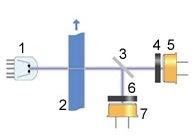
UV absorbance spectroscopy
1 : xenon lamps,
2 : flow cell,
3 : beam splitter,
4 : peak filter,
5 : peak detector,
6 : reference filter,
7 : reference detector
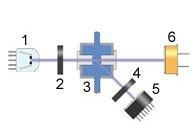
UV fluorescence principle
1 : xenon lamps,
2 : excitation filter,
3 : flow cell,
4 : emission filter,
5 : photomultiplier,
6 : reference photo detector
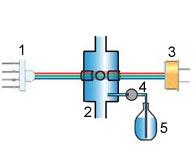
Colorimetric method principle
1 : led,
2 : flow cell,
3 : photo detector,
4 : reagent pump,
5 : reagent tank
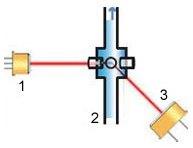
Laser diode turbidity principal (nephelometric)
1 : Laser diode (650 nm or 850 nm),
2 : flow cell,
3 : Photo detector
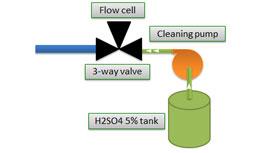
Auto cleaning principle
1 : Auto Cleaning Technique,
2 : 5% H2SO4 Solution,
3 : Adjustable auto-cleaning period,
4 : Auto zero done on cleaning solution
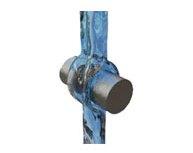
Patented flow cell
1Allows very high level of suspended solid without clogging for all the optical measurements making it suitable for industrial & municipal waste water application.
- The patented flow cell allows very high level of suspended solid without clogging for all the optical measurements making it suitable for industrial and municipal waste water application. The turbidity is automatically compensated by a dual-wavelength method.
- Suitable for sample with high chloride content
- Wetted parts of flow cell make it suitable for most corrosive sample
User-friendly interface
The colour touch screen and intuitive interface available in 8 different languages (Chinese, English, French, German, Italian, Portuguese, Spanish, Turkish) makes very easy to test or configure the analyser. Many test functions allows to test and troubleshoot each element of the analysers (light signal, pumps, solenoid valves, etc...) to setup quickly a maintenance diagnostic.
Communication
The RS232 port supports the MODBUS protocol to transmit each Standard channel value to a SCADA system. Additional parameters are available like status code, error code, calibration values and pumps run time. Basic 4-20 mA output modules can be plugged on the main board for each Standard channel, in the limit of 12 modules. A USB port enables to download on any USB key the last 5000 recorded measurements as well as a diagnostic file containing the configuration and useful information for remote troubleshooting. The new web interface makes possible to drive remotely the analyser from any computer, tablet or i-phone with a web browser. For this, an optional Wi-Fi or Ethernet module is added inside the analyser to connect it to an existing network with an internet gateway. The recorded measurements file can be imported to Excel for graphs or other treatments. The software of the analyser can be upgraded by connecting a USB key.
Multiplexing system
When different streams need to be analysed, for example inlet and outlet of a plant, an optional multiplexing system delivers relay contacts to control external electric-valves or external pumps.
Up to 6 different streams can be selected
The Standard channels can be either duplicated (each one having its own 4-20mA output or MODBUS register), or measured sequentially to fit with the maximum of 16 Standard channels (a MODBUS register tells which stream is currently being measured).
Sampling system
The UV300 can adapt to many different kind of sampling depending of the application : surface water, drinking water, process water or wastewater.
If the water is already pressurized, the sample can be admitted directly inside the analyser with a maximal pressure of 4 bars. Otherwise an optional built-in peristaltic pump, synchronised with the measurement to extend the tubing life time, allows to take the sample directly from a tank located up to 6 meters below the analyser. For demanding applications with long distances, another peristaltic pump in a separate enclosure is proposed as an option. For some applications on river water or wastewater where two sampling pumps are necessary, the UV300 delivers a relay contact to synchronise the primary pump. The delay and running time of each pump can be adjusted easily in the parameters menu of the analyser.
| Parameter | Standard Range | Other Ranges on Request | Typical Repeatability (<10% FS) | Accuracy (Standard Solution) |
|---|---|---|---|---|
| UV254 | 0–200 Abs/m | 0–600 / 0–2000 Abs/m | ±0.05 / ±0.15 / ±0.5 Abs/m | ±2% |
| COD (UV correlation) | 0–100 mg/l | 0–2000 / 0–20,000 mg/l | ±0.05 / ±1 / ±10 mg/l | ±2% |
| BOD (UV correlation) | 0–100 mg/l | 0–1000 / 0–10,000 mg/l | ±0.05 / ±0.5 / ±5 mg/l | ±2% |
| TOC (UV correlation) | 0–100 mg/l | 0–1000 / 0–10,000 mg/l | ±0.05 / ±0.5 / ±5 mg/l | ±2% |
| Nitrate (NO₃) | 0–100 mg/l | — | ±0.1 mg/l | ±2% |
| Colour | 0–100 Pt/Co | 0–1000 Pt/Co | ±1 / ±2 Pt/Co | ±2% |
| PAH (Aromatics) | 0–10 mg/l C₆H₆ | — | ±0.01 mg/l | ±2% |
| Chlorophyll A | 0–100 µg/l | — | ±1 µg/l | ±2% |
| Oil in Water | 0–100 ppm | 0–1000 ppm | ±0.1 / ±1 ppm | ±2% |
| Phosphate (PO₄) | 0–2 mg/l | 0–20 mg/l | ±0.01 / ±0.1 mg/l | ±2% |
| Chlorine (Cl₂) | 0–5 mg/l | — | ±0.05 mg/l | ±2% |
| Nitrite (NO₂) | 0–5 mg/l | — | ±0.1 mg/l | ±2% |
| Aluminium | 0–500 ppb | — | ±10 ppb | ±2% |
| Iron (Fe) | 0–2 mg/l | — | ±0.02 mg/l | ±2% |
| Silica (SiO₂) | 0–20 mg/l | — | ±0.1 mg/l | ±2% |
| Chromium VI | 0–2 mg/l | — | ±0.04 mg/l | ±2% |
| Turbidity (TSS correlation) | 0–10 NTU | 0–100 / 0–1000 NTU | ±0.01 / ±0.1 / ±1 NTU | ±2% |
| pH | 0–14 | — | ±0.01 pH | ±2% |
| ORP | ±2000 mV | — | ±1 mV | ±2% |
| Dissolved Oxygen | 0–25 mg/l O₂ | — | ±0.1 mg/l | ±2% |
| Conductivity | 0–2000 µS | — | ±1 µS | ±2% |
| External Turbidity | 0–4 NTU | 0–40 NTU | — | ±2% |
| External TSS | 0–1500 mg/l | 0–30,000 mg/l | ±1% of reading or ±2 mg/l | ±2% |
| Temperature | 0–80 °C | — | ±0.1 °C | ±2% |
Related products


Why Choose Process Networks?

ISO-Certified Quality
Our ISO 9001:2015 quality management system ensures full traceability across design, installation, calibration and support.
Technical Expertise You Can Reach
When you contact us, you speak directly to an expert — not a call centre.
Trusted Supplier Partnerships
Exclusive access to premium instrumentation from leading global manufacturers in Germany, Japan, the US and across Europe.
Long-Term Support & SLAs
Most customers stay with us for years because we stay with them providing ongoing maintenance, calibration and on-site service.
Proven Field Experience
Thousands of instruments installed and tens of thousands points monitored daily on systems we support.



Speak to a technical expert about this product
Our experts will guide you to the right solution whether you need a single sensor or a site-wide monitoring system.
Office
Process Networks Ltd,
Unit K20 Drinan Enterprise Centre,
Swords, Co. Dublin, K67 NN59
Call
(01) 211 8414
info@processnetworks.ie