

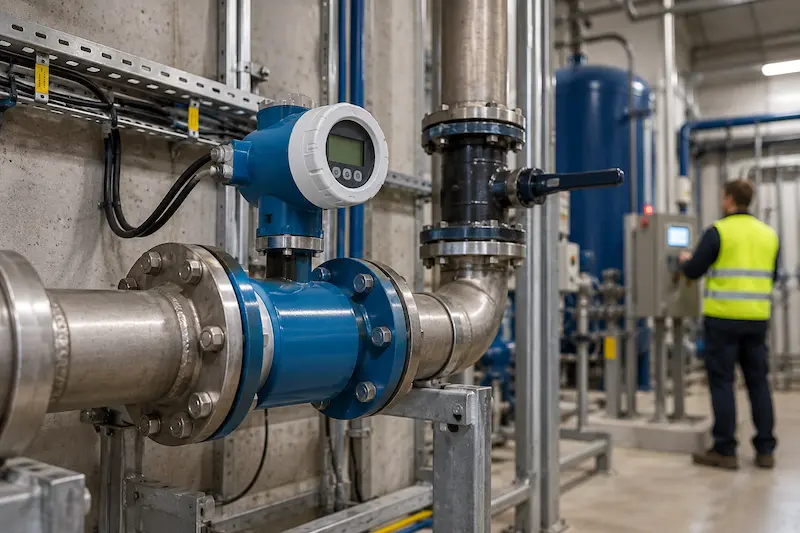
Industrial flow meters play a critical role in accurate monitoring, process control and compliance reporting.
Whether you’re managing wastewater discharge, pump performance, process water, chilled water, industrial effluent or open-channel flows, industrial flow meters give your team the data needed to make better operational decisions.
For engineers, utilities managers, environmental teams and operations leaders, the key question isn’t simply whether flow should be measured, but which flow meter is right for the application.
The answer depends on the medium, pipe or channel conditions, accuracy requirements, installation constraints, maintenance expectations and reporting obligations.
Why industrial flow meters matter
Accurate flow measurement supports three major business and operational priorities: compliance, efficiency and reliability.
#1. Compliance and reporting
For regulated industries, flow data is often required for discharge monitoring, trade effluent reporting, environmental compliance and audit records.
If the flow reading is unreliable, then load calculations, discharge volumes and compliance evidence can also become unreliable. This is particularly important in wastewater, manufacturing, food and beverage, pharma, utilities and environmental monitoring applications.
Industrial effluent monitoring can include continuous quality monitoring, flow and load measurement, turbidity, COD/TOC and pH monitoring, supported by real-time alarms for out-of-spec conditions.
#2. Process efficiency
Flow is one of the clearest indicators of how a process is performing. Poor flow control can point to blocked lines, pump inefficiency, incorrect dosing, unstable batching, heat exchanger issues or water waste.
Flow measurement across liquids, gases and steam as part of process monitoring, utilities monitoring, energy optimisation and early fault detection is crucial in manufacturing and utilities.
#3. Energy savings
Pumps, blowers, cooling systems and treatment processes can waste energy when flow is poorly controlled. Real-time flow data helps teams identify abnormal conditions, optimise pump performance and reduce unnecessary system load.
Common types of industrial flow meters
There is no single “best” flow meter. The right option depends on what you are measuring and the conditions on site.
Magnetic industrial flow meters
Magnetic flow meters are commonly used for conductive liquids such as water, wastewater, process water and industrial effluent.
They are often selected because they have no moving parts in the measurement path and can provide stable measurement in many industrial liquid applications. They are not suitable for non-conductive fluids such as oils, hydrocarbons or gases.
Typical uses include:
- Water and wastewater pipelines
- Industrial effluent
- Process water
- Dosing and batching applications
- Food and beverage liquids, where hygienic versions are required
Best suited when: the pipe is full, the liquid is conductive and stable inline measurement is needed.
Ultrasonic industrial flow meters
Ultrasonic flow meters use sound signals to measure flow. They are widely used in water, wastewater, open-channel and process applications.
Transit-time ultrasonic flow meters measure the difference in travel time between signals sent with and against the flow. These are often used for cleaner liquids and high-accuracy applications.
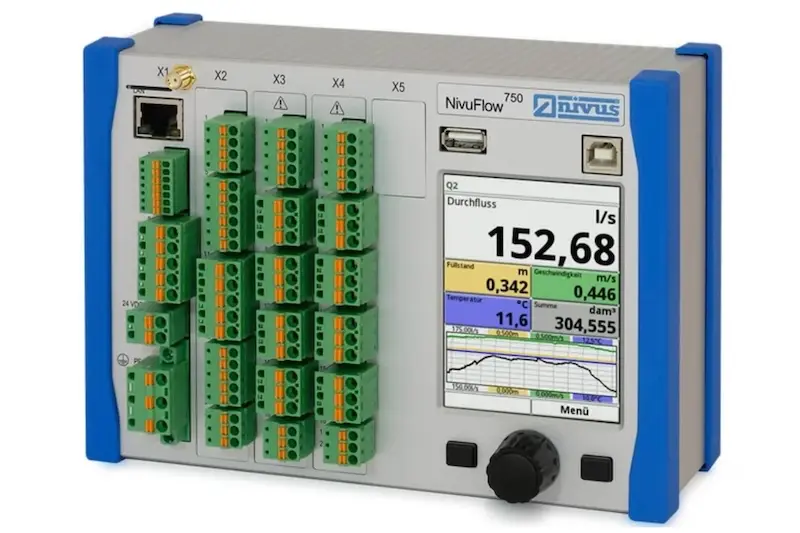
The NivuFlow 650, for example, uses ultrasonic transit-time technology and is designed for accurate flow measurement in open channels, part-filled and full pipes, and surface water bodies.
Cross-correlation flow meters are well suited to more complex or polluted media. They analyse the real flow velocity profile, making them useful in wastewater, stormwater and variable open-channel conditions.
The NivuFlow 750 uses cross-correlation technology for slightly to heavily polluted media in part-filled and full pipes and channels.
Best suited when: accurate measurement is needed in open channels, part-filled pipes, wastewater systems or surface water applications.
Radar flow meters
Radar flow meters are contactless systems that measure surface velocity. Because the sensor does not sit inside the flow, they are useful where sediment, debris, abrasion, aggressive media or difficult access could create maintenance problems.
The NivuFlow 550 is a contactless radar flow meter designed for challenging open-channel applications, including high pollutant loads, sedimentation, debris, restricted installation locations and high discharge velocities at low flow levels.
Best suited when: contactless measurement is preferred, and the site has difficult hydraulic, sediment or access conditions.
Hybrid flow meters
Hybrid systems combine more than one measurement method to improve reliability in difficult locations.
The NivuFlow 7550 combines radar surface velocity measurement with ultrasonic sideward velocity profile sensing. This makes it suitable for part-filled pipes, channels, surface waters, overflow situations, sedimentation-prone sites and applications where one measurement technology alone may not provide enough confidence.
Best suited when: the application is hydraulically complex, access is limited or measurement redundancy is valuable.
Portable flow meters
Portable systems are useful for surveys, verification, troubleshooting, temporary monitoring and short-term compliance projects.
Examples include:
- NivuFlow Mobile 550 for mobile contactless radar flow metering
- NivuFlow Mobile 650 for mobile ultrasonic transit time measurement
- NivuFlow Mobile 750 for portable cross-correlation measurement
- NivuFlow Stick for mobile discharge measurement in rivers, streams and canals
Best suited when: measurement is temporary, multi-site or needed before specifying a permanent system.
How to choose industrial flow meters for your site
Choosing a flow meter should start with the application, not the product catalogue.
#1. What are you measuring?
Start with the medium:
- Clean water
- Wastewater
- Industrial effluent
- Sludge
- Process liquid
- Cooling water
- Steam
- Gas
- River, stream or surface water
The medium determines which technologies are viable. Magnetic flow meters need conductive liquids, while radar flow meters are useful where contactless measurement is preferred.
#2. Is the pipe full, part-filled or open-channel?
This is one of the most important selection questions.
A fully closed pipe may suit magnetic or ultrasonic technologies. A part-filled pipe or open channel usually requires flow velocity plus level measurement, and may benefit from radar, ultrasonic or hybrid systems.
#3. How accurate does the measurement need to be?
A compliance-critical discharge point, billing point or process control point may require higher accuracy, traceability and verification than a general monitoring point.
For high-accuracy open-channel or surface-water applications, transit-time systems may be appropriate. For complex wastewater profiles, cross-correlation systems may be more suitable.
#4. What are the site constraints?
Consider whether:
- The pipe can be cut
- The process can be stopped
- The channel is safe to access
- There is sediment or debris
- There is enough straight pipe run
- Power and communications are available
- The site is remote, hazardous or exposed
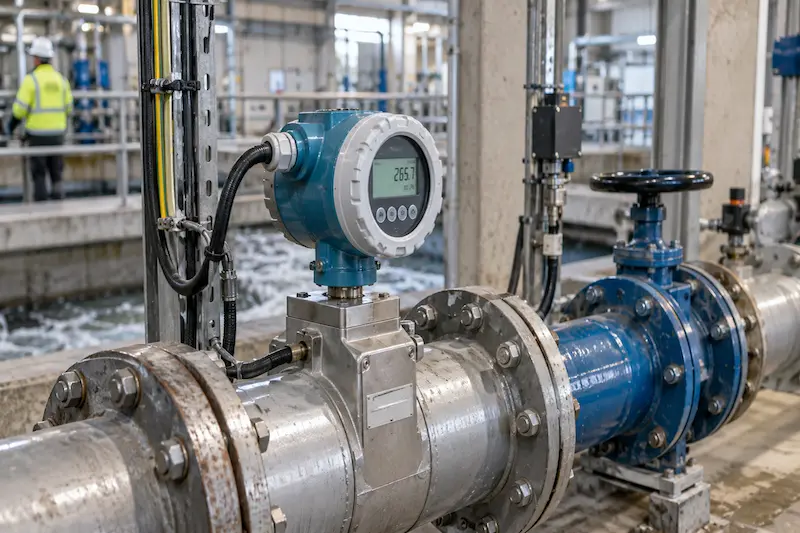
Installation conditions often determine whether an inline, clamp-on, contactless, portable or hybrid solution is most practical.
#5. What data output is required?
A flow meter may need to integrate with:
- SCADA
- PLC
- BMS
- Cloud dashboards
- Data loggers
- Alarm systems
- Compliance reporting platforms
Process Networks’ project content highlights integration with SCADA, PLC, BMS, cloud platforms, data loggers, gateways, Modbus, 4–20 mA, digital I/O and IP networks.
Common flow meter selection mistakes
Choosing based on pipe size alone
Pipe size matters, but it is not enough. You also need to understand the medium, flow range, pipe condition, solids content, temperature, pressure, access and data requirements.
Ignoring low-flow conditions
Some of the most important risks occur during low-flow, night-flow or dry-weather conditions. Make sure the selected technology performs reliably across the full expected range.
Underestimating sediment and debris
A meter that performs well in clean water may struggle in a high-sediment channel. Contactless or hybrid systems may be better where debris, bed load or sedimentation are ongoing issues.
Forgetting about data integration
A flow meter that cannot communicate with the wider monitoring system may create extra manual work. Integration with SCADA, cloud dashboards and alarms should be considered early.
How Process Networks supports flow measurement projects
At Process Networks, we support industrial and environmental organisations with flow measurement as part of wider monitoring, automation and compliance systems.
That includes:
- Instrument selection
- Site assessment
- Flow meter supply
- Installation and commissioning
- Calibration and verification
- SCADA, PLC and cloud integration
- Alarm configuration
- Reporting support
- Ongoing maintenance and SLAs
We’re proud to be a technical partner that helps customers understand what they need to measure and why, backed by industrial-grade instruments, calibration, compliance support, cloud-enabled monitoring and long-term service.
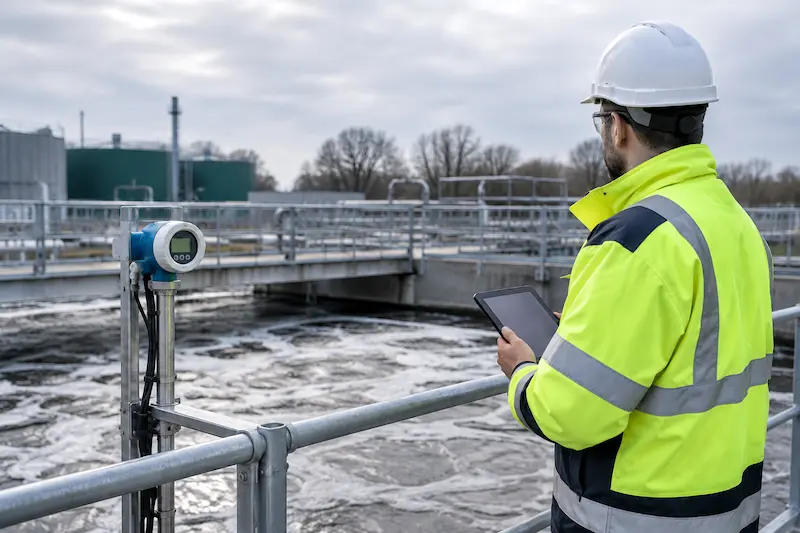
Process Networks: Your supplier of industrial flow meters across Ireland
If your organisation needs better visibility, stronger compliance, lower downtime or more reliable process control, the right flow meter can make all the difference. Process Networks supplies high-quality flow measurement instruments across a range of complex industrial process environments.
From single sensors to complete multi-point monitoring systems, our technical team can help you choose a solution tailored to your application, installation conditions, accuracy requirements, and long-term operational goals.
With ISO-certified quality, trusted supplier partnerships, real-world field experience and ongoing support, we give you accurate data, practical insight and confidence in every measurement.
Speak to us today to find the right flow meter for your application and start turning reliable measurement into better decisions, better compliance and better process performance.